5 Awesome Soketi Alternatives
 Yulei Chen
Soketi is a fast, open-source WebSocket server that's fully compatible with the Pusher protocol. It's a popular choice for developers who want real-time features like live updates, chat, and notifications without the per-message pricing of managed services. Soketi is completely free to self-host, and on Sliplane you can get it running for just €9/month with one click - no server setup required. Check out our easy deploy guide to get started.
But Soketi might not be the perfect fit for every use case. Maybe you need a managed service with zero infrastructure to maintain, a protocol beyond Pusher compatibility, or better horizontal scaling out of the box. Here are 5 awesome alternatives worth considering.
1. Pusher
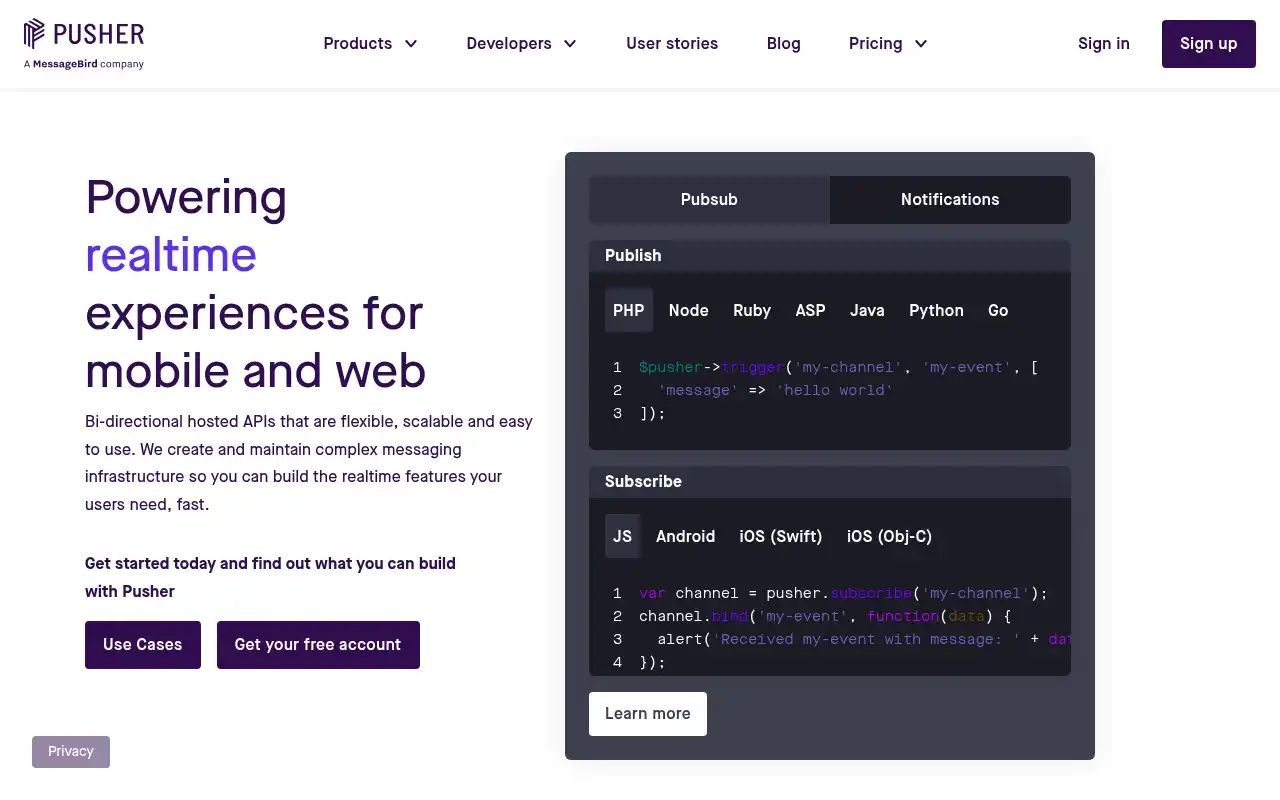
Pusher is the original managed real-time messaging platform that Soketi was built to be compatible with. It handles all the infrastructure so you don't have to think about servers, scaling, or uptime. Pusher offers Channels (WebSocket pub/sub) and Beams (push notifications) as separate products.
- Features: Pub/sub channels (public, private, presence, encrypted), webhooks, REST API for server-side publishing, client libraries for 10+ languages, Functions (serverless event processing), debug console, and usage analytics.
- Why You Should Use It: If you want zero infrastructure management and a battle-tested service used by thousands of companies, Pusher is the safe choice. The SDKs are mature and well-documented, and since Soketi implements the Pusher protocol, migrating between the two is straightforward. Pusher also offers GDPR and HIPAA compliance out of the box.
- Why Not: Pricing scales with message volume and concurrent connections, which can get expensive fast. Even the Startup plan at $49/month only gives you 500 connections and 1M messages/day. Self-hosting Soketi on a $9 server gives you unlimited messages.
- Pricing: Free Sandbox (100 connections, 200K messages/day). Startup at $49/month (500 connections, 1M messages/day). Pro at $99/month (2,000 connections, 4M messages/day). Plans go up to $1,199/month, with custom Enterprise pricing beyond that.
2. Centrifugo
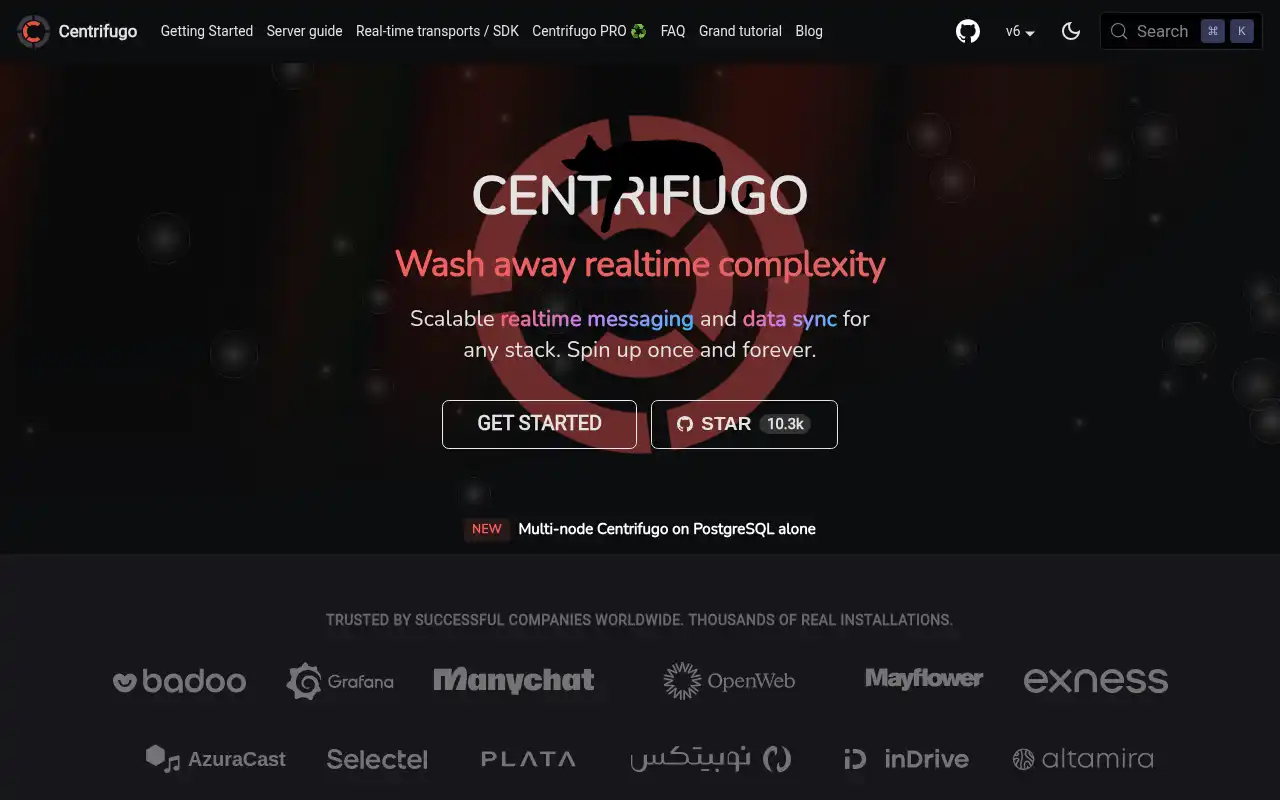
Centrifugo is a scalable, language-agnostic real-time messaging server written in Go. It's been around for over a decade and is used in production by companies like VK, Badoo, ManyChat, and Grafana. Where Soketi focuses on Pusher protocol compatibility, Centrifugo has its own protocol and supports multiple transports.
- Features: WebSocket, HTTP-streaming, SSE, gRPC, and WebTransport support, channel subscriptions with history and presence, JWT-based auth, delta updates, online presence tracking, connection event proxying, and official SDKs for web and mobile. Recent updates added PostgreSQL as a broker (no Redis needed) and real-time key-value collections.
- Why You Should Use It: If you need transport flexibility beyond WebSockets or want a server that can handle 1 million connections on a single node, Centrifugo is hard to beat. The Go implementation is extremely efficient, and the recent PostgreSQL broker means you can run a multi-node cluster without adding Redis or NATS to your stack.
- Why Not: Centrifugo uses its own protocol, so you can't drop it in as a Pusher replacement without changing your client code. The learning curve is steeper than Soketi's "just use the Pusher SDK" approach. The PRO version with analytics and advanced features requires a corporate license.
- Pricing: The open-source version is completely free. Centrifugo PRO (analytics, tracing, push notifications, SSO) is available to corporate customers with flat pricing based on company size - contact sales for a quote. Self-hosting costs only what you pay for infrastructure.
3. Ably
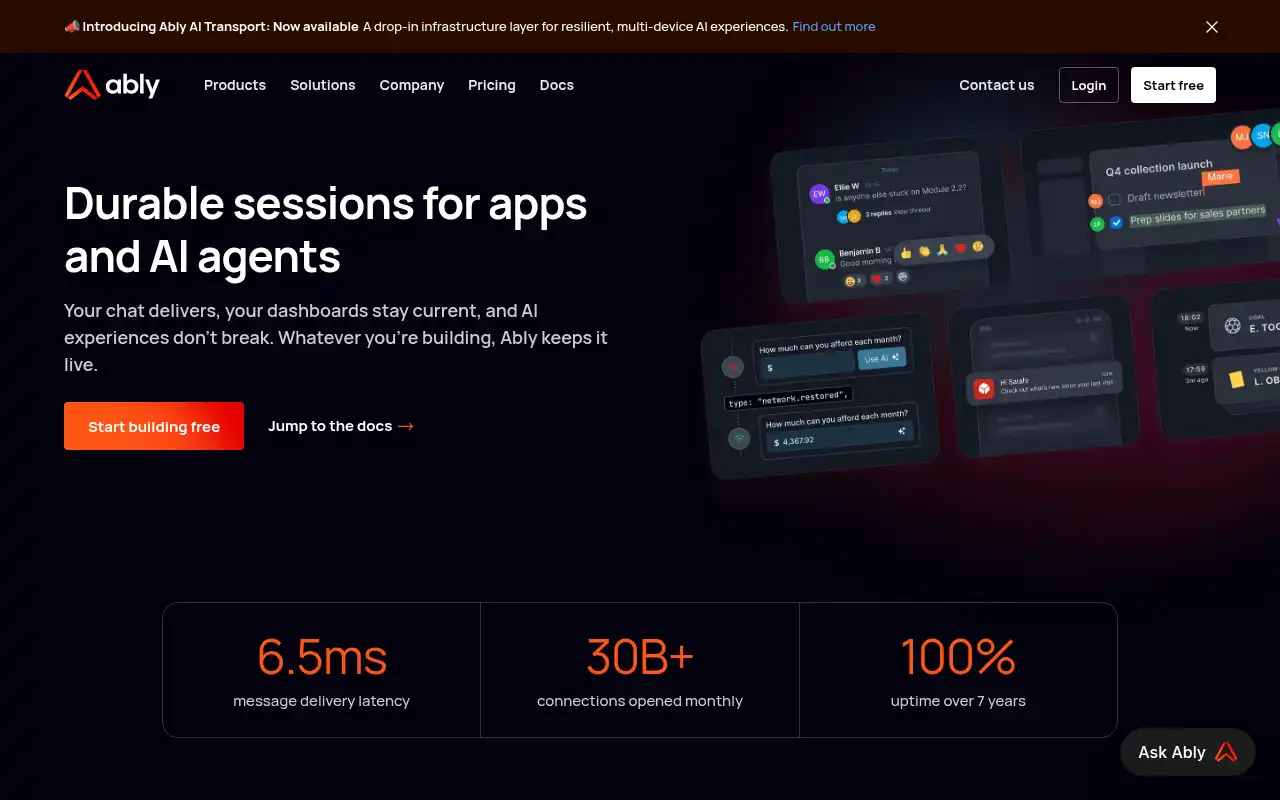
Ably is an enterprise-grade real-time messaging platform that goes well beyond simple pub/sub. It provides a global edge network with guaranteed message ordering, exactly-once delivery, and 99.999% uptime SLAs for enterprise customers.
- Features: Pub/sub channels, presence, message history, push notifications, webhooks, integrations (Kafka, AMQP, Datadog), global edge network across 16+ data centers, message ordering guarantees, connection state recovery, and client SDKs for 25+ platforms including IoT.
- Why You Should Use It: When reliability is non-negotiable, Ably delivers. The global edge network means low latency worldwide, and features like exactly-once delivery and automatic failover make it ideal for financial trading, gaming, or any app where lost messages cost real money. The platform also handles complex use cases like fan-out to millions of subscribers.
- Why Not: Ably is fully managed with no self-hosting option, so you're locked into their platform. Pricing is usage-based and can be hard to predict. The complexity of the platform is overkill if you just need basic pub/sub for a chat feature or live notifications.
- Pricing: Free tier (6M messages/month, 200 concurrent connections). Standard and Pro plans with pay-as-you-go pricing: $2.50 per million messages, $1.00 per million connection minutes. MAU-based pricing also available at $0.05/user. Enterprise with custom pricing and 99.999% SLA.
4. Mercure
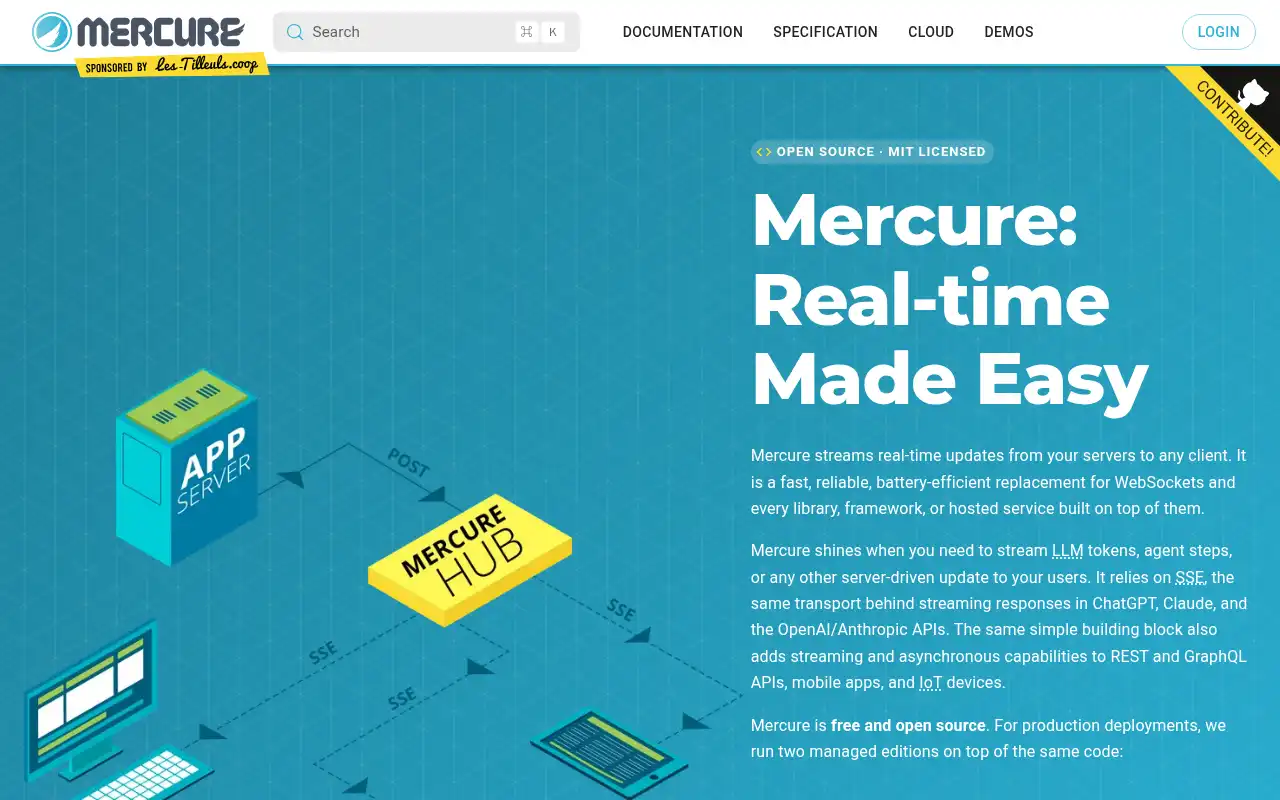
Mercure is an open-source real-time protocol and server that takes a fundamentally different approach from Soketi. Instead of WebSockets, it uses Server-Sent Events (SSE) - the same transport behind streaming responses in ChatGPT and Claude. It's written in Go and designed to work with any existing HTTP infrastructure.
- Features: Built on SSE (native browser support, no client library needed), automatic reconnection and state reconciliation, JWT-based authorization for private updates, presence API, event store for message history, URI template-based topic subscriptions, and Docker/Kubernetes-ready deployment.
- Why You Should Use It: If your use case is primarily server-to-client (dashboards, notifications, live feeds, AI streaming), Mercure is simpler than WebSockets. SSE works through proxies and load balancers without special configuration, requires no client library, and is more battery-efficient on mobile. The Symfony and API Platform integrations make it the go-to choice for PHP developers.
- Why Not: SSE is one-directional (server to client only). If you need bidirectional communication like chat or collaborative editing, you'll need to pair Mercure with a traditional HTTP API for the client-to-server direction. The ecosystem is smaller than Pusher-compatible tools.
- Pricing: Open-source hub is free (AGPL licensed). Mercure Cloud starts at €30/month (Hobby, 250 connections) up to €500/month (Pro++, 10,000 connections). Enterprise edition with custom pricing for self-hosted HA deployments. Free for worker cooperatives with fewer than 10 employees.
5. Sockudo
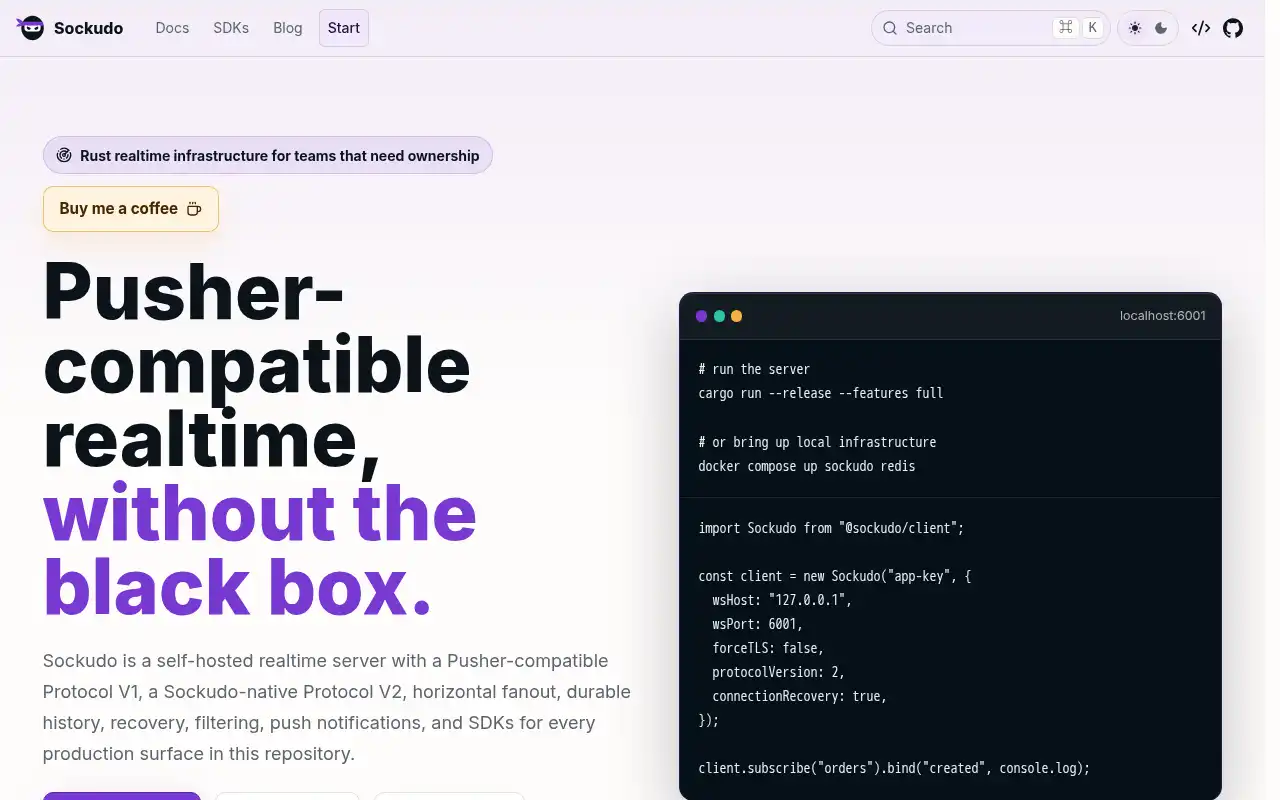
Sockudo is a high-performance, Pusher-compatible WebSocket server written in Rust. Think of it as a spiritual successor to Soketi, built from the ground up for speed and memory efficiency. It claims to be 6.5x faster than alternatives with sub-5ms latency.
- Features: Full Pusher protocol compatibility (works with Laravel Echo and all Pusher SDKs), dual protocol support (V1 for Pusher compat, V2 with connection recovery and mutable messages), built-in Redis, Redis Cluster, NATS, and Kafka adapters, MySQL and DynamoDB backends for app management, Prometheus metrics, rate limiting, and SSL/TLS support.
- Why You Should Use It: If you're currently using Soketi and want better performance, Sockudo is the most natural upgrade path. It's a drop-in replacement that speaks the same Pusher protocol but runs on Rust instead of Node.js. The V2 protocol adds features like exactly-once delivery and mutable messages that neither Soketi nor Pusher offer.
- Why Not: Sockudo is newer and less battle-tested than Soketi. The managed cloud service (Sockudo Cloud) is still in private beta. The community is smaller, which means fewer tutorials and Stack Overflow answers when you run into issues.
- Pricing: Completely free and open source for self-hosting (MIT license). Sockudo Cloud (managed) is in private beta with a free tier, Starter, Growth, Scale, and Enterprise plans. Cloud pricing promises to be around 30% less than competitors like Pusher, with no per-seat fees.
Conclusion
| Tool | Best For | Ease of Setup | Focus | Cloud Pricing |
|---|---|---|---|---|
| Soketi | Pusher drop-in replacement | Easy | Pusher-compatible WebSockets | Free (self-host only) |
| Pusher | Zero-ops managed service | Very Easy | Managed WebSocket pub/sub | Pusher $49-1,199/mo |
| Centrifugo | High-performance, multi-transport | Moderate | Language-agnostic real-time | Free OSS, PRO custom |
| Ably | Enterprise reliability | Easy | Global edge messaging | Ably $2.50/M messages |
| Mercure | Server-to-client streaming | Easy | SSE-based real-time | Mercure €30-500/mo |
| Sockudo | Max performance, Pusher compat | Moderate | Rust-powered WebSockets | Free OSS, Cloud in beta |
Each tool fills a different gap: Pusher for a fully managed experience with zero infrastructure, Centrifugo for raw performance and transport flexibility, Ably for enterprise-grade global messaging, Mercure for SSE-based server-to-client streaming, and Sockudo for maximum Pusher-compatible performance in Rust.
Soketi remains a great choice if you want a simple, free, Pusher-compatible WebSocket server that you can self-host. But if your needs go beyond basic Pusher compatibility, one of these alternatives might be a better fit.
If you want to self-host Soketi, check out our guide on self-hosting Soketi the easy way.